I build AI that retrieves, understands, and sees: the science, the models, and the end-to-end capabilities that make it work at scale and in the physical world.
Retrieval science
Predicting how an approximate index will behave before it is built, from the geometry of the embeddings alone. Recall forecasts land within 0.03 of measured on unseen million-document corpora.
Language models
Adapting embedding and sparse models to vocabulary they were never trained on, and pricing multi-vector and late-interaction retrieval at production scale.
Visual intelligence
Computer vision and visual document retrieval: models that read pages and images directly, indexed and served at the same economics as text.
AI in the physical world
Perception systems that see and act at the edge, measured on what they get right per watt and per dollar.
- Research
- Closed Forms and Synthetic Twins (arXiv:2609.00364, cs.IR, August 2026) predicts approximate-index recall from label-free embedding statistics, within 0.03 of measured recall on an unseen million-document corpus.
- Open source
- Member of the OpenSearch Leadership Committee. Built lock-free concurrent graph construction for the jVector plugin for OpenSearch.
- Industry
- Led engineering organizations of more than 75 people at AWS, Oracle Cloud Infrastructure, and DataStax, building search, SIEM, and observability systems that process petabytes a day.
- Patents
- Patents in distributed systems and storage technologies.
Latest research
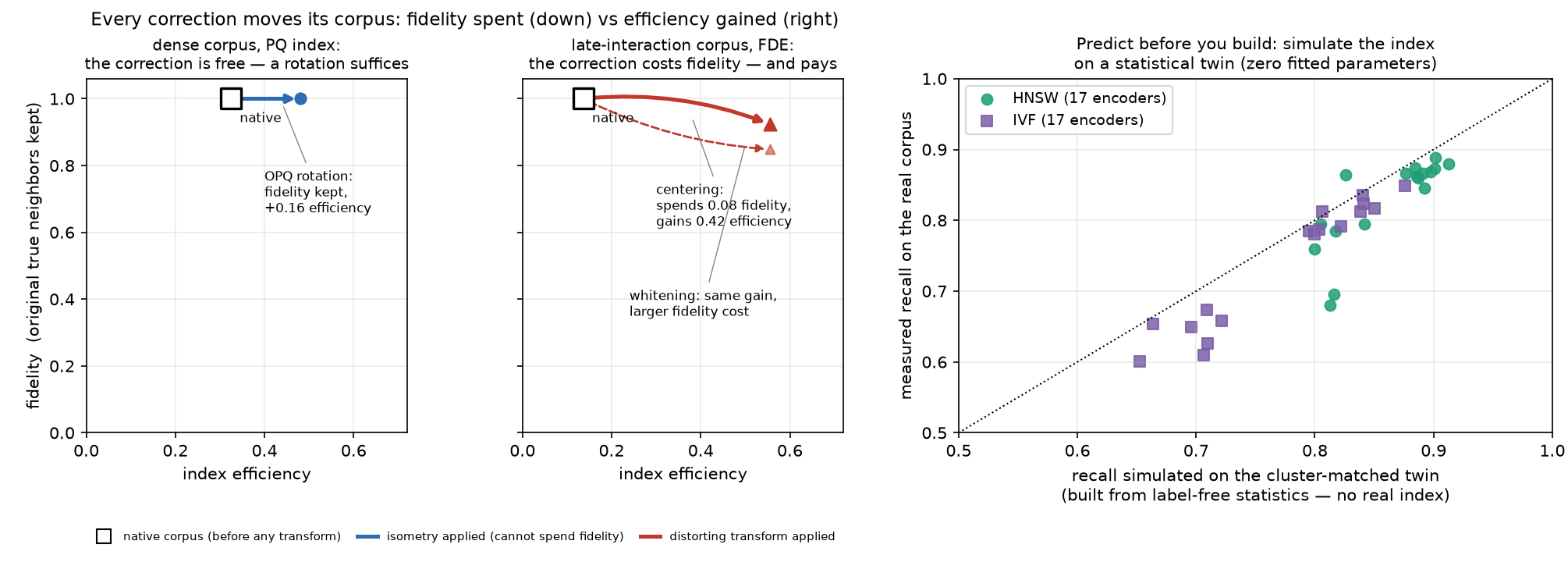
Embedding models are benchmarked as if retrieval were exact. In production they sit behind HNSW, IVF, product quantization, or fixed-dimensional encodings whose recall the benchmarks never measure. The paper shows that recall is predictable before the index exists, from one cheap measurement pass over the raw embeddings, and that the same geometry is trainable.
Selected writing
Talks
From Embeddings To Index: A Practitioner's Guide To Domain-Adapted Neural SearchOpenSearchCon, Prague
Watch 2025Vector Search Beyond The Hype: OpenSearch and Vector DatabasesOpenSearchCon
Watch 2024Lucene And Beyond: Core Storage Extension In OpenSearchOpenSearchCon
Watch 2023Journey To 750 Node ClustersOpenSearchCon
Watch